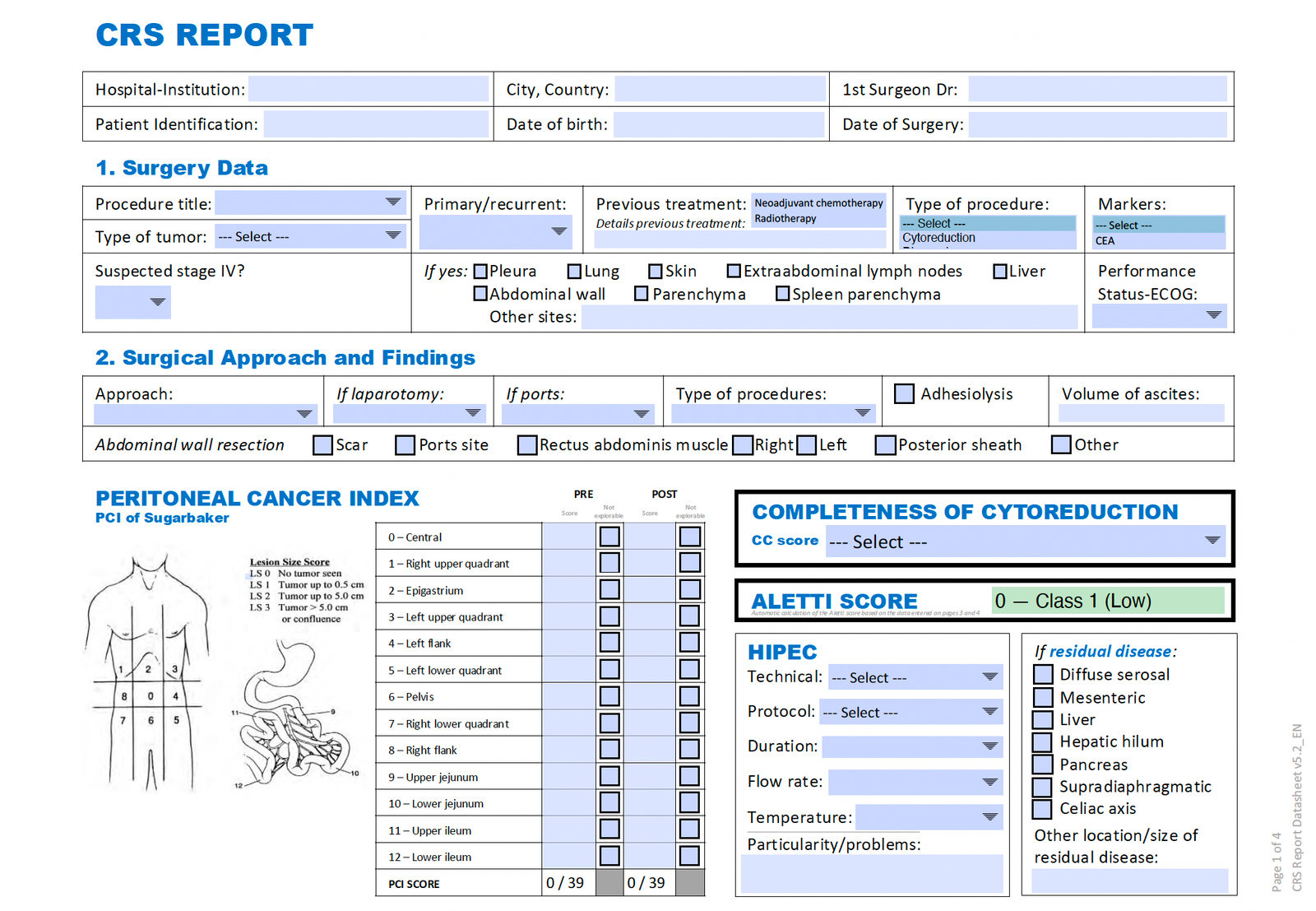
A complete, fillable PDF version of the standardized CRS Report operative report for cytoreductive surgery. It mirrors the full structure of the online tool in a single 4-page form that can be completed, saved and printed — usable offline or as a backup to the web application.
The form covers the entire procedure: surgery and patient data, the Peritoneal Cancer Index (Sugarbaker, pre- and post-cytoreduction), surgical approach and findings, peritonectomy procedures, visceral resections, lymphadenectomy, verification of occult peritoneal spaces, drains and intraoperative details.
Three scores are computed automatically from the data entered: the PCI score (out of 39, adjusted for non-explorable regions), the Aletti Surgical Complexity Score (with a colour-coded class — green / yellow / red), and the Completeness of Cytoreduction (CC) score.
Available for download in .pdf format, in English and French
Attached documents:
 crs-report-datasheet-cytoreductive-surgery
crs-report-datasheet-cytoreductive-surgery
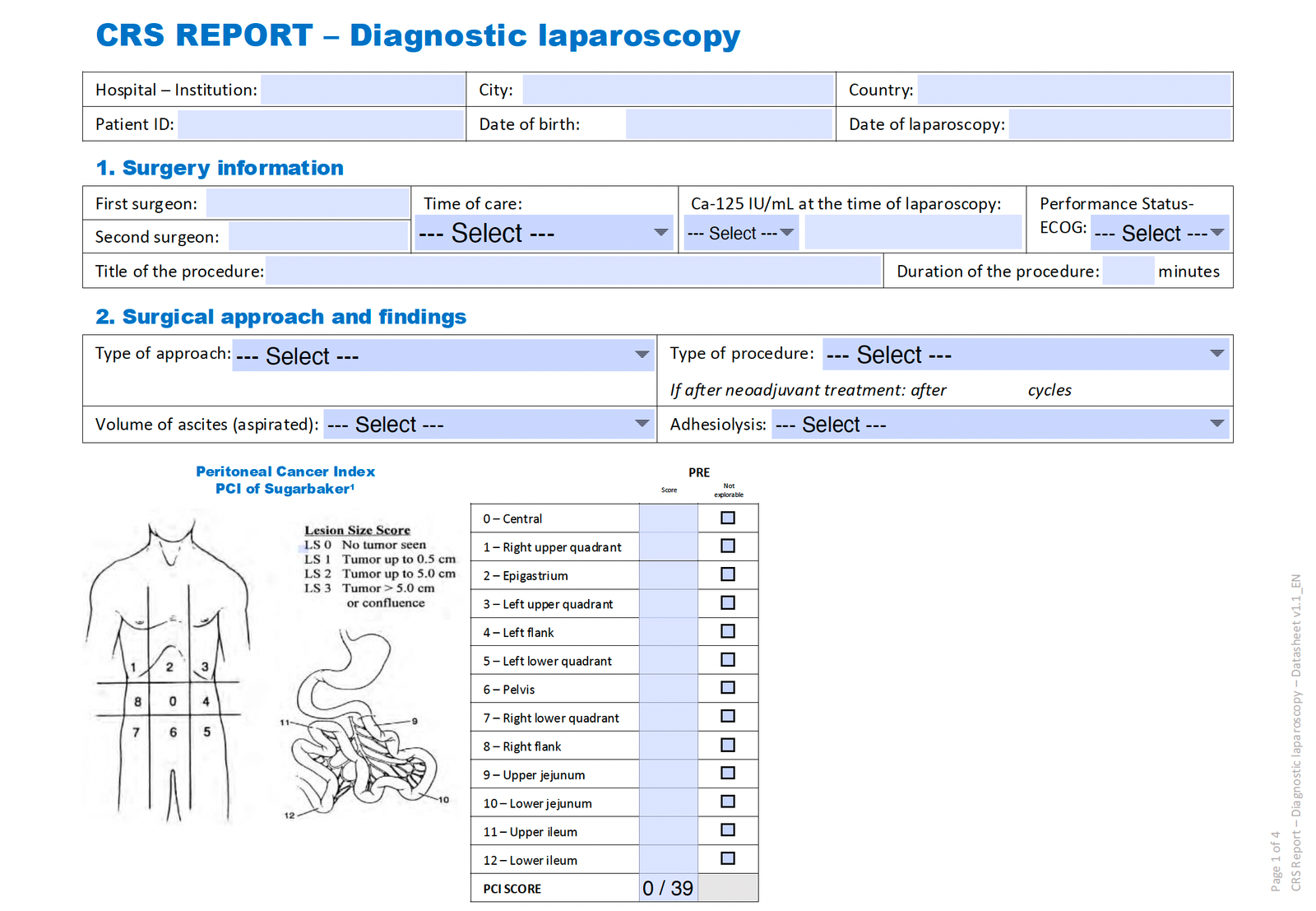
A fillable PDF report for exploratory/diagnostic laparoscopy in peritoneal surface malignancy, designed to assess tumor extent and resectability before deciding on cytoreductive surgery. A standalone 4-page form that can be completed, saved and printed — usable offline or as a complement to the online tool.
The form covers the full laparoscopic assessment: surgery information (surgeons, time of care, CA-125, ECOG performance status, procedure duration), surgical approach and findings, the Peritoneal Cancer Index (Sugarbaker), the Fagotti and modified Fagotti scores (Peritoneal Index Value), biopsies and cytological examinations, drainage, PIPAC, planned treatment and intraoperative complications.
Two scores are computed automatically from the data entered: the PCI score (out of 39, adjusted for non-explorable regions) and the Fagotti / modified Fagotti score (PIV), with predictive thresholds for the likelihood of complete cytoreduction. Each score accounts for non-explorable areas, so the denominator adjusts dynamically.
Standardized in English for research data extraction. Also available in French.
Attached documents:
 crs-report-datasheet-coelioscopie-diagnostique
crs-report-datasheet-coelioscopie-diagnostique
The Peritoneal Cancer Index (PCI) combines cancer implant size with cancer distribution, throughout 13 abdominopelvic regions, producing a quantitative score. The abdomen and the pelvis are divided by lines into nine regions (regions 0-8). The small bowel is then divided into four regions. Regions 9 and 10 define upper and lower portions of the jejunum, and regions 11 and 12 define the upper and lower portions of the ileum. The lesion size (LS) of the largest implant is scored as lesion size 0 through 3 (LS-0 to LS-3). LS-0 means no implants are seen throughout the areas. LS-1 refers to implants that are visible up to 0.5 cm in greatest diameter. LS-2 identifies nodules greater than 0.5 cm and up to 5 cm. LS-3 refers to implants 5 cm or greater in diameter. If an organ is coated by a mat of tumour (confluent disease) or if there is tissue adhesions, the region or site is also scored as LS-3.
The lesion sizes are then summed for all abdominopelvic regions. A numeric score from 0-39 indicates the extent of the disease within all regions.
Jacquet P, Sugarbaker PH. Clinical research methodologies in diagnosis and staging of patients with peritoneal carcinomatosis. Cancer Treat Res 1996;82:359-74.
The lesion sizes are then summed for all abdominopelvic regions. A numeric score from 0-39 indicates the extent of the disease within all regions.
Jacquet P, Sugarbaker PH. Clinical research methodologies in diagnosis and staging of patients with peritoneal carcinomatosis. Cancer Treat Res 1996;82:359-74.
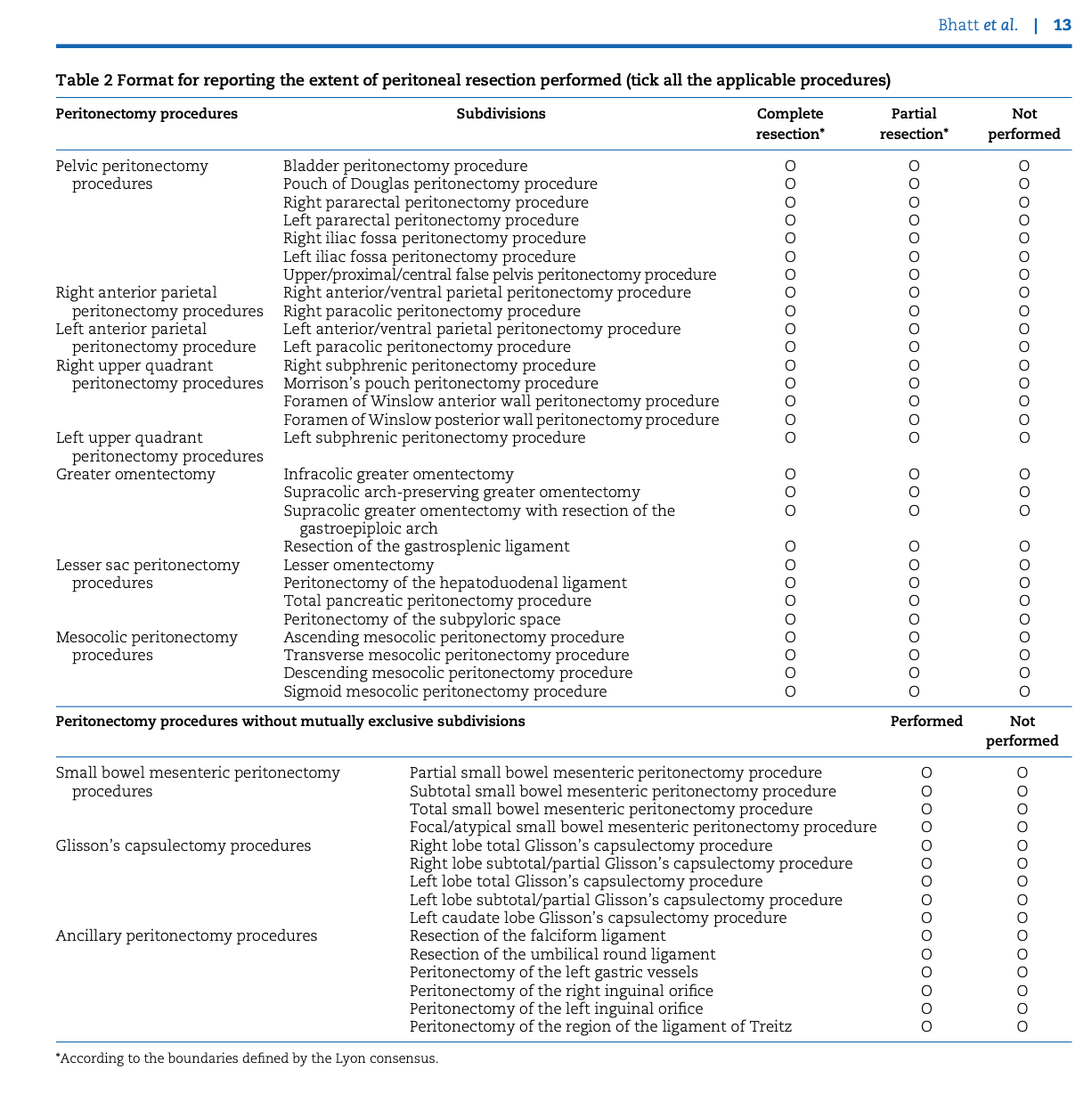
Peritoneal Surface Malignancies CRS REPORT is available for download
Attached documents:
 Peritoneal Surface Malignancies CRS REPORT
Peritoneal Surface Malignancies CRS REPORT
The Simplified Peritoneal Cancer Index (SPCI) calculates the tumour load, incorporating the tumour thickness with extent of peritoneal dissemination. The abdomen is divided into seven anatomical regions: left and right subdiaphragmatic space, subhepatic space/stomach, omentum/transverse colon, small bowel/mesentery, right lower abdomen and pelvis. Each region incorporates certain anatomical structures and scoring is based on the visualized maximum thickness of tumour nodules in each region, from 0 to 3, indicating no, small (< 2 cm), moderate (2-5 cm) or large (>5 cm) involvement, respectively.
The SPCI adds up to a maximum score of 21.
Verwaal VJ, van Tinteren H, van Ruth S, et al. Predicting the survival of patients with peritoneal carcinomatosis of colorectal origin treated by aggressive cytoreduction and hyperthermic intraperitoneal chemotherapy. Br J Surg 2004;91:739–46.
The SPCI adds up to a maximum score of 21.
Verwaal VJ, van Tinteren H, van Ruth S, et al. Predicting the survival of patients with peritoneal carcinomatosis of colorectal origin treated by aggressive cytoreduction and hyperthermic intraperitoneal chemotherapy. Br J Surg 2004;91:739–46.
The Gilly classification takes into account the size (< 5 mm, 5-20 mm, > 20 mm) and distribution of malignant implants (localized or diffuse).
The stages range from 0 to 4.
Gilly FN, Carry PY, Sayag AC, et al. Regional chemotherapy (with mitomycin C) and intra-operative hyperthermia for digestive cancers with peritoneal carcinomatosis. Hepatogastroenterology 1994;41:124–9.
The stages range from 0 to 4.
Gilly FN, Carry PY, Sayag AC, et al. Regional chemotherapy (with mitomycin C) and intra-operative hyperthermia for digestive cancers with peritoneal carcinomatosis. Hepatogastroenterology 1994;41:124–9.
Fagotti score is a laparoscopy-based score for predicting surgical resectability of ovarian cancers, taking into account seven critical parameters for the surgical resection, as follows: 1) Peritoneal carcinosis: a score = 2 is allotted only to the patients with unresectable massive peritoneal involvement as well as with a miliary pattern of distribution; on the contrary, the score is 0 in the case of carcinosis involving limited area (as along the paracolic gutter or the pelvic peritoneum) being surgically removable by peritonectomy; 2) Diaphragmatic disease: a score = 2 is agreed in the case of wide spread infiltrating carcinosis, or confluent nodules to the most part of the diaphragmatic surface; 3) Mesenteric disease: a score = 2 is granted when large infiltrating nodules or an involvement of the root of the mesentery are supposed on the basis of limited movements of the various intestinal segments. On the other hand, small nodules potentially treated by Argon-Beam Coagulator are not considered for scoring; 4) Omental disease: a score = 2 is allotted when tumor diffusion is observed along the omentum up to the large stomach curvature, whereas isolated localization are excluded; 5) Bowel infiltration: a score = 2 is agreed in the case that a bowel resection is assumed or when milaryc carcinosis on the ansae is observed; 6) Stomach infiltration: a score = 2 is granted when an obvious neoplastic involvement of the gastric wall is observed; 7) Liver metastases: a score = 2 is allotted in the case of any surface lesions.
Fagotti-modified score is constructed by the selection of four (Diaphragmatic disease, Mesenteric disease, Stomach infiltration, and Liver metastases) of the seven parameters.
The Fagotti and Fagotti-modified scores add up to a maximum score of 14 and 8, respectively.
Fagotti A, Ferrandina G, Fanfani F, et al. Prospective validation of a laparoscopic predictive model for optimal cytoreduction in advanced ovarian carcinoma. Am J Obstet Gynecol 2008 Dec;199(6):642.e1-6.
Brun JL, Rouzier R, Uzan S, Daraï E. External validation of a laparoscopic-based score to evaluate resectability of advanced ovarian cancers: clues for a simplified score. Gynecol Oncol 2008, 110(3):354–59.
Fagotti-modified score is constructed by the selection of four (Diaphragmatic disease, Mesenteric disease, Stomach infiltration, and Liver metastases) of the seven parameters.
The Fagotti and Fagotti-modified scores add up to a maximum score of 14 and 8, respectively.
Fagotti A, Ferrandina G, Fanfani F, et al. Prospective validation of a laparoscopic predictive model for optimal cytoreduction in advanced ovarian carcinoma. Am J Obstet Gynecol 2008 Dec;199(6):642.e1-6.
Brun JL, Rouzier R, Uzan S, Daraï E. External validation of a laparoscopic-based score to evaluate resectability of advanced ovarian cancers: clues for a simplified score. Gynecol Oncol 2008, 110(3):354–59.