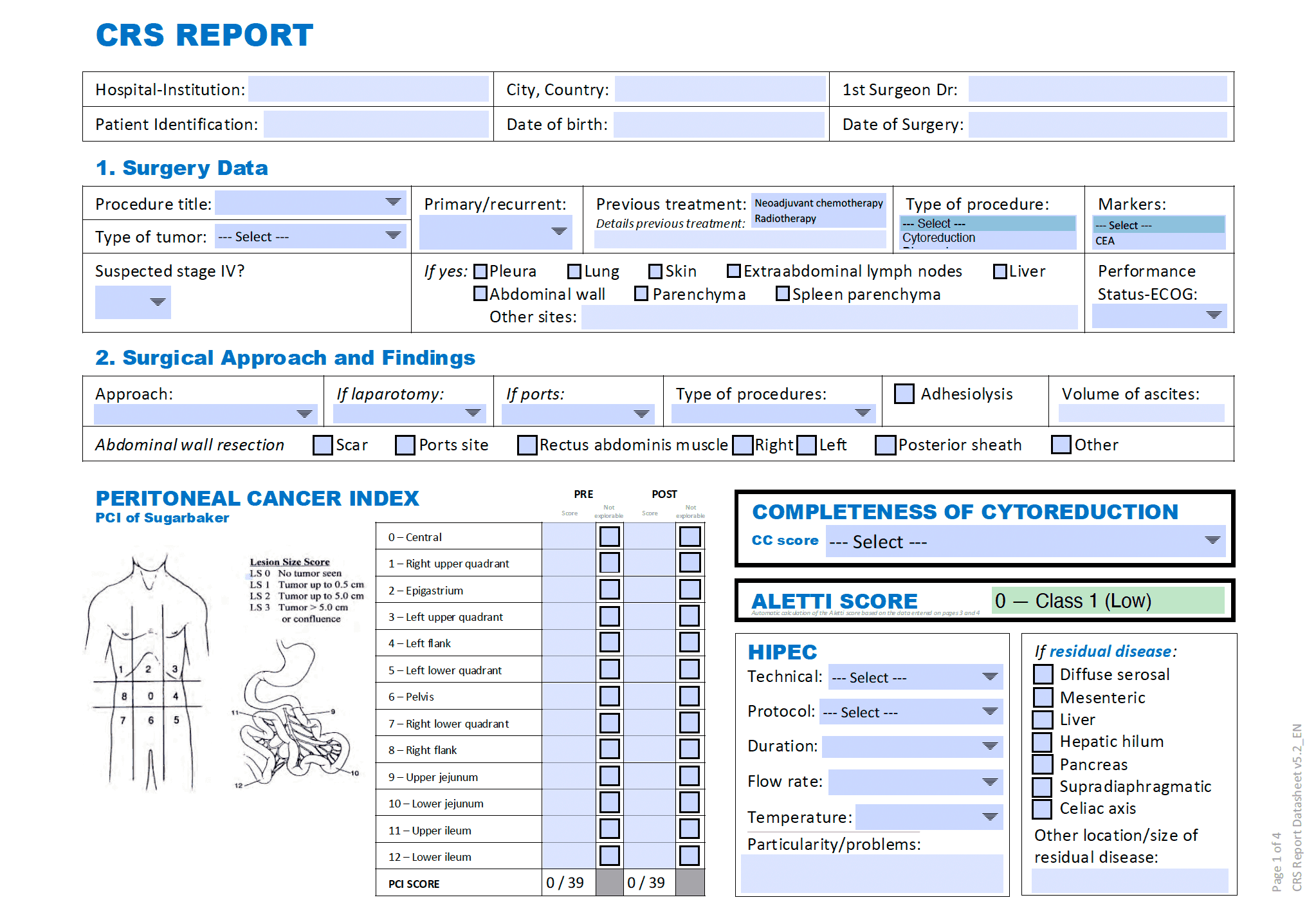
The Peritoneal Cancer Index (PCI) provides a standardized assessment of the extent of peritoneal malignancy. It combines tumor implant size and lesion distribution across 13 abdominopelvic regions, generating a reproducible quantitative score used to guide treatment decisions and evaluate surgical outcomes.
The Operative Report module standardizes the documentation of peritonectomy procedures and visceral resections. It enables structured data entry for each surgical procedure, ensuring consistency, traceability, and comparability between centers and surgeons. All reports can be exported in multiple formats for clinical review or research integration (.pdf, .json, .csv).
The Documentation space provides access to reference materials, user guides, and implementation protocols. It supports clinicians in the correct use of the tool and promotes harmonized data collection in accordance with PSOGI–ESGO–ISSPP consensus definitions.
The operative report datasheet is a complete, fillable PDF version of the standardized CRS Report operative report for cytoreductive surgery. It mirrors the full structure of the online tool in a single 4-page form that can be completed, saved and printed. The form covers the entire procedure: surgery and patient data, the Peritoneal Cancer Index (Sugarbaker, pre- and post-cytoreduction), surgical approach and findings, peritonectomy procedures, visceral resections, lymphadenectomy, verification of occult peritoneal spaces, HIPEC, drains and intraoperative details.
Three scores are computed automatically from the data entered: the PCI score, the Aletti Surgical Complexity Score and the Completeness of Cytoreduction (CC) score.

Immediate to pick up: generate a complete operative report in minutes through a clear, fluid interface, with no prior training required.
A complete list of surgical steps and procedures that prevents any omission in the report — and can also be used as a checklist directly in the operating room.
Codified procedures and a standardised format that structure data collection and feed the databases dedicated to prospective and retrospective studies.
CRS Report is used to feed the French national ovarian cancer database and to support prospective studies such as TORPEDO. By producing standardized, structured operative reports, the tool helps build high-quality clinical research data.